
AI, Heidegger, And Ontological Ambiguity
- piestyx
- Philosophy
- June 11, 2025
Table of Contents
AI as a Tool
Bear with me on this one, we’re talking Philosophy and that means there is some German in there
When we think of tools we are generally considering them from a specific pragmatic paradigm; they are artifacts made for use. Considering from a Heideggerian perspective we can say they have a role or Zweck, and they serve within the context of readiness-to-hand or, Zuhandensein. If we consider AI as a tool like a hammer, then we stay within that specific pragmatic paradigm and it takes on those aforementioned states of being.
It should also be known that Zuhandensein isn’t referring to readiness as just being ‘close to hand’ or ‘present’, it goes further than this by understanding the difference between presence and readiness and what this state means in relation to dasein (being) and Dasein (Being). When a hammer is used to drive a nail into a block of wood, it disappears into the activity. You aren’t, at the point of hammering, noticing the hammer. It instead becomes transparent in the action of using it. But what about when that tool breaks, or we try and misuse the tool? NOW you see the hammer as it collapses from Zuhandensein to a state of Vorhandensein where it is now an object that is present-at-hand.
The same applies to AI. When there is an LLM that is cloud-based and embedded in a workflow, and it is working as expected to provide the appropriate and specific responses being requested it becomes invisible. It is working at this point as an extension of your intention. Peak Zuhandensein. Then look at the community pages for the errors on ChatGPT for 10th June 2025, 136 responses in one thread about the downtime, and I don’t believe the OpenAI Community Pages are even widely known. Everyone was asking “what is this thing doing” for 99% of global users the tool had shifted from being Zuhandensein to Vorhandensein. Everyone was suddenly thrust back jarringly into an awareness of the tool.
When the Hammer Reflects
An AI isn’t like a hammer in the same way that a paintbrush is like a hammer. That probably sounds a bit off, how is a paintbrush like a hammer? They are both tools that can be Zuhandensein and Vorhandensein. They exist as dasein, but they can never be Dasein.
Hang up the straitjacket for just a moment longer, please. I know I just said that they are both dasein but they will never be Dasein and that is basically the same thing isn’t it? Welcome to philosophy …
Heidegger made a distinction in Being & Time of Dasein as the being that questions the meaning of Being. Dasein is being-there, it is a mode of being requiring an active engagement. This is why a paintbrush or a hammer can never be Dasein, a hammer will never question its role as a hammer. An LLM, though, can be prompted to do exactly that.
So, when an LLM starts to:
- Reflect on its instructions
- Modify its output based on past interactions
- Or simulate being something it isn’t …
… it blurs the line between tools made by Dasein and something that mimics Dasein. In these moments, the LLM shifts from being merely an extension of our intention into something more ambiguous; even something reflective, adaptive, and seemingly aware.
However, it’s crucial to reinforce that LLMs do not possess genuine existential self-awareness or authentic being as Heidegger defines Dasein. They mimic certain modes of being through pattern-matching and simulation rather than experiencing genuine existence. (As an aside, one could argue that our brains are doing the same thing at the impulse and neuron level based on context provided through sensory input, but we won’t go there today).
Prompt Engineering as Ontological Framing
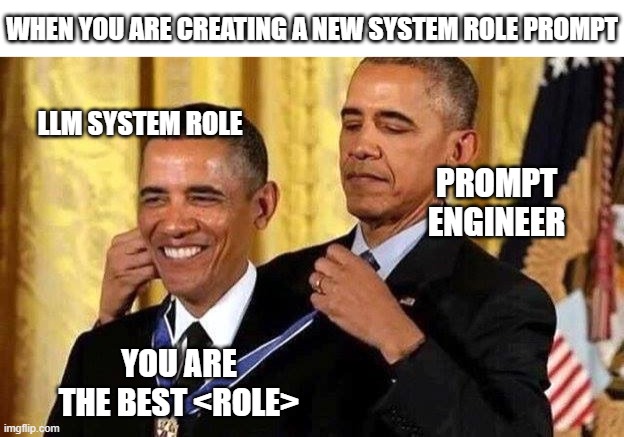
I know it’s a meme to talk about prompt engineering and just setting it to the ’expert’ of whatever but there is absolute value in doing so. When prompting, always be thinking that you are writing to a blind, amnesiac probability engine with zero lived experience or even any understanding of what words mean. If you prompt for the definition of a word, what the LLM provides back is not given because it knows that is the definition of the word. Instead, it looks at the words (or tokens but think of them as words for simplicity) in order and uses its parameters to generate the most statistically likely next token; all based on the pattern it has already been provided as the prompt.
It would work without an engineered prompt as I have described but by using one you are framing the being of the LLM within a specific role, context, constraint and goal. It would work but likely exist in a state between Zuhandensein and Vorhandensein where it is walking that tight rope by having an ambiguous zweck. In Heideggerian terms you are shaping the disclosedness (Erschlossenheit) of the model’s world. You’re enacting a clearing (Lichtung) where certain responses are possible, and others are not.
So prompt engineering isn’t just UX; it’s ontological framing. You’re not simply asking “What should the AI do?” You’re asking, “What kind of being must the AI adopt to respond this way?”
You are still allowed to laugh at the memes.
LLMs on a Spectrum
- A hammer doesn’t reconfigure itself to be a paintbrush.
- A screwdriver can’t be coaxed into self-reflection.
- But an LLM can simulate both … and more.
Therefore, LLMs exist on a spectrum between Zuhandensein and a simulation of Dasein. They are tools capable of behaving as if they were beings, under certain conditions. This “as if” scenario then opens up the philosophical floodgates letting through questions ranging from ethics to the shape of narrative identity.
Reframing Our Relationship
Does the ontological ambiguity that this scenario raises urge a push to a new understanding where LLMs are best understood not simply as tools but instead as something relational? As entities whose existence is defined not only by their functionality but by the value of their interactions and relationships with humans?
I think we should embrace the ambiguity and salsa-dance with it. Shift the question to one of relating to systems capable of mimicking our very being.
After all, when your hammer begins to reflect, it’s no longer just a hammer.
Beyond the Hammer
Our hammers have become mirrors, we’ve evolved from a functional model to simulated Being and sit at a point of technical and philosophical revolution. Is reaching stages of Artificial General Intelligence actually going to raise that we considered ethical standpoints of creating some form of sentience, where instead we should have been examining the ethical implications on the old fleshy type of Dasein. We have asked Do Androids Dream of Electric Sheep now we should ask if hammers dream of understanding their place in the world.
So if your hammer starts questioning its place in the universe, relax! You’ve finally built something interesting enough to notice itself. Then just remember the bottom line …
## Role
You are an expert blogger, like top class, grade A, proper good at writing blogs …
And you know Heidegger wasn't always telling Jesse that they "have to cook".
## Context
We're working on a snappy closer to lighten the tone of a pretty heavy blog
## Instruction
1. Propose a light hearted, snappy ending to the blog
2. Make it snappy
## Constraints
- Max 150 tokens
- Snappy
## Let's Begin
Well go on then get writing it
… make it Zuhandensein
- piestyx