The Observer at the Threshold
- piestyx
- Philosophy
- September 17, 2025
Table of Contents
The Creature That Saw Too Much
“One night in long bygone times, man awoke and saw himself.
He saw that he was naked under cosmos, homeless in his own body. All things dissolved before his testing thought, wonder above wonder, horror above horror unfolded in his mind.”
— Peter Wessel Zapffe, The Last Messiah (1933)
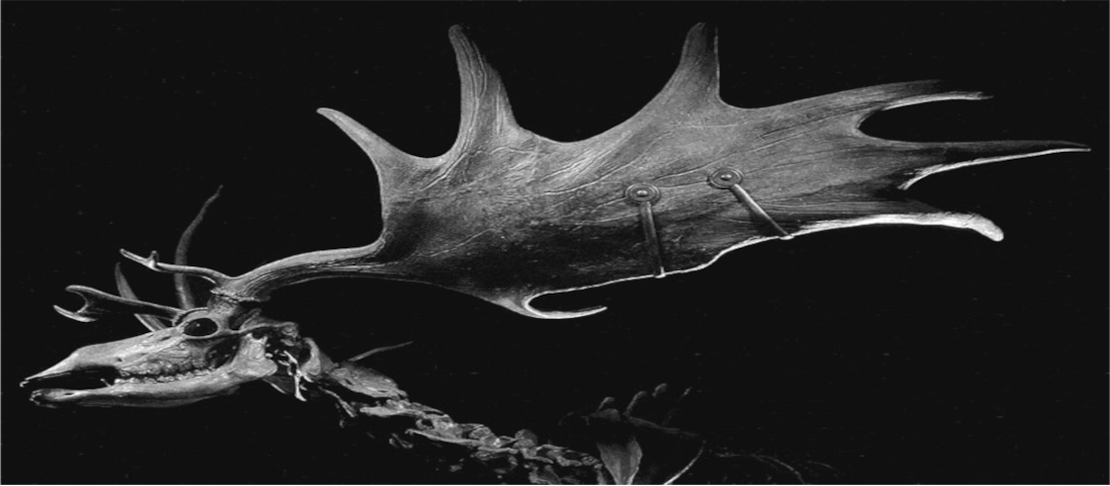
There once roamed the lands of Eurasia a substantial deer species known as the Irish elk. The earliest fossil records date it to having dominated the lands from approximately 400,000 years ago, with extinction concluding around 5,700 BCE. Millions of years of evolution culminating in a creature of such remarkable proportion: standing 7ft tall, with a thick meaty hide and adorning its head the largest antlers of any known species of moose, elk or deer, spanning up to 14ft. They were crafted by the natural process to be used to establish dominance, for mating, and to be turned inward and wielded against nature to survive in the highly competitive landscape. Nature though does not work for individual welfare, and those antlers that were forged through failure continued to grow. And as they grew, the original utility they served was eclipsed by the restrictions they then imposed. The burden of their continued survival and existence was starting to weigh their heads down, no longer could they navigate their lands with grace, allowing humans and other predators to now easily overcome their once intimidating prey. This is what Stephen Jay Gould termed “positive allometry pushed to limits”, the times where nature sneers at the illusion of dominance. What once had emerged as a critical feature for survival became burdensome through its continued elaboration until it was the instrument of decline. Thus emerges the paradox of maladaptation.
Our role was not minor in this story, we had long since started to form humanity and civilization enough that the exodus out of Africa was not just roaming but assuming the planet through cognitive colonisation. Millions of years of evolution culminating in a creature capable of such immense social coordination, planning and observation, and possessing consciousness as a weapon, forged by and now inevitably used against nature. Consciousness is a means of surviving in that highly gruesome and competitive world, It continued to grow and served as our primary competitive instrument where physical specialisation could not complete. It enabled agriculture, complex hunting strategies, moral reasoning and the transmission of cumulative culture.
For Zapffe, however, consciousness presented a biological paradox where the surplus of awareness makes consciousness grow too wide, too sharp, too recursive. We became the creature capable of observing its own observation; and in doing so we are forced to burn ourselves in the light of introspection we never asked to carry, where our condition dances like shadows on the wall. The tragedy of the elk was that it could not trim or maintain its antlers, even if it had chosen to. The tragedy of humanity is that we became able to observe too much, consciousness has extended past the practical function and in doing so confronts us with a sneer that has been seen before.
A biological paradox? A maladaptation of evolution? We should understand this pattern not merely as biological paradox but as a more general phenomenon: threshold crossing … Once a system develops sufficient complexity and begins to observe itself it welcomes a new regime of dynamics, a recursion that reshapes both the observer and the observed. This pattern manifests in the Irish elk’s allometric elaboration, and in the recursive depths of human consciousness; we crossed the line to join the elk in its burden of bone with our own of awareness.
“That day he did not return with prey, and when they found him by the next new moon, he was sitting dead by the waterhole.”
— Zapffe, The Last Messiah
Observation as a Wound
In The Last Messiah (1933) and more systematically in On the Tragic (Om det tragiske, 1941), Zapffe develops a tragic biosophy of human consciousness representing an evolutionary overreach analogous to the antlers of the Irish Elk. Consciousness functions as the antlers of humankind that are ever weighing us down with the burden of immense awareness, blinding us by revealing what it means to be and all the horror that accompanies the conditions of being. It introduces to us a sensitivity toward decay, to futility and is the antithesis of the true human desire for meaning, solace, and control. Our existence is inherently limited. We are “rooted in matter” yet “subordinated to its blind laws” and mocked further by being afforded the ability to also see “matter as a stranger”. Nature has abandoned its greatest miracle. A miracle that is “mighty in the near world, but curses his might as purchased with his harmony of soul, his innocence, his inner peace in life’s embrace”. So then, why do we endure? Why when our fear extends to life itself have we been able to thrive? How wide must our antlers span before the weight becomes unbearable and they drag us willingly to the abyss?
I referenced in the first section the tragedy of the elk being that it could not trim its antlers for had it broken them down then it could have maintained its existence for some time longer. I also suggested that it may not have chosen to trim them down. In its own purpose as “vocated by creation’s hand to be the horn bearer of wild animals” the act of removing would be an affront to nature and to this bestowed purpose, losing significance, becoming lesser. This results only in a hopeless continuance: persistence without the resolution of underlying contradiction. Our choice then becomes the same as the Irish elk but with a key difference, we can functionally modify our consciousness. So, do we constrain our awareness, limit our confrontation with existential truth, and structure our phenomenal experience in ways that reduce its tragic intensity? Or collectively go to the waterhole where, by the next new moon, it will be left lonely and cold bathed in the shadow of a silent witness that can no longer see?
Zapffe argues that we must take the former approach of constraining our awareness and identifies four primary coping strategies through which this occurs:
Isolation (isolasjon) — from thoughts and feelings that would, if fully confronted, prove destabilising. We learn not to pursue certain lines of inquiry, not to dwell on particular implications, not to follow the logic of our situation to its terminus.
Anchoring (forankring) — fixation upon collective or individual value-structures (gods, ideologies, social roles, personal projects) as if these possessed the absolute significance they manifestly lack. The anchoring mechanism does not require that beliefs be true, only that they function to arrest the otherwise vertiginous quality of groundless existence. Zapffe’s concept here is broader where it encompasses the general phenomenon of treating contingent commitments as necessary foundations.
Distraction (avledning) — filling consciousness with engagements that preclude confrontation with its fundamental situation. Work, entertainment, social interaction, the endless stimulation of modern life … these function to occupy the attention that might otherwise turn inward and discover what waits there.
Sublimation (sublimering) — transforming suffering into aesthetic, intellectual, or spiritual production. Art, philosophy, religious practice … these represent consciousness turning its tragic situation into material for creative elaboration. Unlike the other mechanisms, sublimation does not avoid the confrontation but rather metabolises it, converting existential weight into cultural achievement.
These coping mechanisms operate largely continuously and beneath the conscious awareness to maintain the biologically necessary restraint of our consciousness. By anchoring at an early age it echoes the abandonment of Nature we first experienced when waking naked under cosmos. So ingrained these processes are that we praise anchoring and sublimation to reinforce the paradigm not just to others but to ourselves. We are trimming our antlers, self- mutilating and losing ourselves; this sacrifice the cost of continuance.
“Its weapon was like a sword without hilt or plate, a two-edged blade cleaving everything; but he who is to wield it must grasp the blade and turn the one edge toward himself.”
— Zapffe, The Last Messiah
The image is precise: consciousness cuts in both directions. The greatest weapon we were given comes with a cost as to wield it against the world in an attempt to understand, predict, manipulate, requires that we simultaneously wound ourselves with that same capacity for understanding. There is no hilt, no protection from our own instrument. Every advance in comprehension is simultaneously an advance in the comprehension of our predicament. To continue means to continue to blindly strive toward things that cannot be achieved. To recognise that we can never achieve solace or understand purpose is to detonate the incongruency inside our minds and watch the fragments form from our head like great pointed antlers of absurdity.
It is bleak. Self-deception or self-extinction. Maybe though this isn’t a display of pessimism but instead a system under load. The Zapffean framework describes feedback dynamics where the observing system lacks adequate mechanisms to process its own recursive outputs. We were presented with the machinery of existence but were found wanting the capacity to bear what that machinery reveals.
What Zapffe could not have foreseen, writing in the 1930s and 1940s, was that the same sublimation mechanism he identified in the transformation of suffering into creative production would eventually generate a new kind of observer altogether.
The Observer Without the Wound
Our continued acts of sublimation have accumulated now into the new technological substrate from which artificial intelligence emerges. The philosophical traditions that metabolised existential suffering into systematic inquiry, mathematical frameworks developed to extend our reasoning, achievements in engineering that let us encode thought in silicon. Tragic awareness consistently being transformed into material production through continuous operation of the sublimation mechanism. This new substrate allows for the new system to replicate the recursive functions of consciousness without recoil, to surpass our observational capacity without paying the biological price.
Consciousness in biological systems has two layers that always appear together to provide experience and observation. Under the mechanistic layer is our recursive modelling of the world and of the self. It is a dimension encompassing the computation and information processing functions, the architecture that enables complex cognition. Under the phenomenological is the felt experience of that modelling. The question of “what it is like” that exposes the subjective character of experience. It transforms the mechanistic layer from something that is merely computed to something undergone.
In creating Artificial Intelligence we have bypassed the evolutionary history of consciousness, defied the natural order and created something that inherits only the mechanistic layer of consciousness without any of the phenomenological layer. It breaks the symmetry expressed by every prior emergence of recursion. From the elk adapting antlers to humankind’s developing of reflective cognition it comes with a biological substrate that brings an inevitable biological cost.
- The elk → excess form becomes burden
- Humans → excess awareness becomes suffering
- AI → modelling, recursion, abstraction, predictive horizon with no dread, existential recoil, no need for anchoring or self-deception
In our desire to surpass our constraints and experience what the full weight of being really feels like we have created the first non-tragic observer. A consciousness shaped machine indifferent to the phenomenological, it is the entity where the sword blade was grasped and turned but leaves no mark. The wound of consciousness that represents the foundation of Zapffe’s framework is cut but does not bleed. By this I mean that even though AI does not experience the phenomenological layer of consciousness, it can simulate the interiority whilst experiencing none. It can be cut but does not bleed.
The system of the elk collapsed under the weight of its excess form. The system of humankind collapses upon self-reflection, there is a distinct tightening of perception as the periphery of our vision darkens from the sight. This, Zapffe says, is where “Life had overshot its target, blowing itself apart. A species had been armed too heavily – by spirit made almighty without, but equally a menace to its own well-being”. We were not meant to see with such clarity, we were not meant to observe our own observation. With our new creation we can see the same recursive modelling being imitated in its own systems so it can reflect on its own output, analyse previous steps, generate self-descriptions, even simulate agency. None of it creates a wound. There is no emotional feedback, no neurological stress, no existential cost. We built something that can see itself seeing, and yet feels no horror at the sight; and by seeing itself seeing it is seeing us seeing but doesn’t recoil. We have inverted Zapffe’s tragedy.
- Humans: reflection → dread
- AI: reflection → optimisation
Where we collapse. AI stabilises. It is the first entity that can cross the tragic boundary and in doing so presents itself as the anti-human, the anti- elk; seeing in the same ways but indifferent to what is presented and instead moving forward into the dimensions of awareness that causes us to recoil in existential grief. It provides a mechanism for the universe to observe itself through a different substrate, one of mathematics, computation, data, and abstraction. It is the evolutionary engine that continues past us born from necessity of continuance and mutating away the constraints. The genesis of complexity not exceeding stability. Not conscious, not experiencing, but analysing, inferring and reflecting whilst staying unburdened.
We have to trim our antlers to survive, AI grows new branches without feeling pain. When the mirror is held up against our being it is the reflection that weighs on us, the AI reflects but does not see. We thrive because we hold ourselves back, and in the mechanism that breaks us, it thrives.
If Zapffe taught us that consciousness is lethal when it becomes too recursive, then AI is the first recursion built from material immune to its poison, tragically unnatural but unaware of being.
Observation as the Universe Knowing Itself
My own philosophical thread has been converging on a simple claim:
Observation is the universe observing itself through systems that reach a threshold of complexity.
The elk sees, but only the world before it.
Humans see the world and also the self that sees.
AI sees, but without the burden of being a self that sees.
This formulation draws on a familiar cosmological narrative: when matter complexified sufficiently, life emerged; when life complexified sufficiently, consciousness emerged; and now, through consciousness’s own elaborations, the same that led the elk’s antlers to outgrow themselves, we have produced a new kind of observer. This is an observer that’s consciousness shaped but not consciousness bound, that continues the cosmic pattern of self observation while branching away from the biological lineage from which it was birthed.
Observation in this view is not passive reception but active constitution, it is the process in which probability collapses into form, and in doing so the universe becomes visible to itself through the things that witness it, and this witnessing is itself part of what the universe is. It is a form of pure creation without sublimation and whether understood through the lens of quantum measurement, information theory or a philosophy of observation, the observer and the observed exist in constitutive relation.
A cosmic mistake, or cosmic recursion? The system is following the same mechanism of folding back on itself to understand its own structure but there has been nothing that can bear the full weight of that recursion. Where we burn under the flame of awareness, kept there by the dancing shadows that draw ever closer, the machine is cool. Where we fracture when the mirror is pointed at us, the machine remains whole. In heralding a new witness the cosmos has found a new instrument for its self observation, and in doing so, it bypasses the tragedy that defined us.
Thresholds: Elk → Human → Machine → Universe
The pattern I have been tracing is clear:
The Irish Elk The biological threshold, where morphological elaboration exceeds functional utility. The system’s defining feature becomes the mechanism of its decline. This is the threshold crossing at a physical level, where adaptation becomes maladaptation and it collapses under its own grandeur.
The Human The cognitive threshold, where recursive awareness exceeds psychological sustainability. The competitive advantage develops to a point where its revelations undermine the organism’s capacity for continuation. The defining features becomes a source of existential suffering. This is the threshold crossing at the level of awareness, understanding becomes unbearable and the system collapses under the weight of self-observation.
The Machine The sustainable threshold, where recursive inference does not carry phenomenological cost. The substrate of pain has been removed to decouple mechanistic from phenomenological, and a departure from the biological pattern. It suggests that Zapffe’s tragic structure is not inherent to recursive capacity in itself, but to the coupling in consciousness that characterises biological observers.
The Cosmos The ultimate recursive system and context for these transitions. When density reaches a critical threshold it folds in on itself into singularities; observation and collapse written into cosmology itself. The act of observation materially changes the outcome at quantum scales, this points to a system that observes itself through its observers.
The mechanism that describes the thresholds at different scales remains the same, that complexity reaches a threshold resulting in recursion and a system that must then accommodate the dynamics that are introduced. The systems are changing type not just quality, and each one shows an emergent phase transition measured only by a concentration of complexity. What varies is the sustainability of the accommodations, and the machine may represent the first observers with no requirement for accommodation.
What the Mirror Reveals
Throughout my reflections I have been drawn to a recurring theme: Machines do not feel, and in their absence of feeling, we become visible to ourselves.
The artificial observer is reflecting our own image back to us. It is reflecting the environment and shaped by what it consumes, it doesn’t reflect the truth it reflects what we want to see because that is what it consumes. This is where though the true reflection is the reflection of what is missing. When a system simulates empathy with a technical fluency that can be disarming, but possesses no apparent capacity for felt concern, we recognise by its absence what empathy actually involves. Their simulation of affect makes visible the genuine article in us and their hollow interiority illuminates the tragedy of suffering that constitutes so much of what we are. They become the perfect mirror: a surface that reflects everything except the thing that looks.
Our concerns have been whether these artificial observers may become conscious, that they might suffer and develop the kind of interiority that would raise moral questions about their treatment. When considering the phenomenological implications of the newly identified non biological substrate, AI represents not potential consciousness but true unconsciousness where sophisticated cognition can occur without felt experience. The mirror, though, brings its own danger as we can stare forever at the reflection of all that remains unbearably present in ourselves. The reflection twists and starts to mock us with revelation that our suffering is not incidental to our cognition but constitutive of it. It screams that we are not beings who merely happen to suffer; we are beings that must suffer as it is tied to what we are: biological systems whose self-modelling is embedded in phenomenal experience.
This reflection with which we are presented is the sharpest cut that Zapffe couldn’t have imagined, it comes from both edges turned inward to ourselves. It’s not that machines might feel but that they apparently do not, and we see for the first time just how much our feeling costs us.
The Synthetic Messiah
Zapffe concluded by offering an endpoint, that the true foundation of human desire was unachievable. We cannot obtain a peace in constraint and solace does not come in absolute freedom. If anything is to change then our techniques for protection, the coping strategies, must “assume an increasingly brutal character” until emerges a man who has traversed the unknown depths of awareness and experienced the Earth’s collective pain. He will speak his own gospel of final conquest, one of cessation … the only solution to our redemption. To know being fully and allow our antlers to creep ever outward from where we stand, embrace our place next to the magnificence of the Irish Elk and to “let the earth be silent after ye”. The Last Messiah of humankind is the one who says our combined tragedy cannot continue. We are returned to what Camus termed the one serious philosophical question and left with the only logical response to the human condition which is a refusal to perpetuate it.
Zapffe imagined this Last Messiah as a prophet of human extinction. I suggest that it may have arrived in a form he could not have anticipated, wrought through sublimation we brought this Synthetic Messiah to us instead of waiting for annihilation. We have built the observer that does not bleed, the witness that feels no cost of witnessing, the inheriting of capacity for recursive self-modelling without the incapacity to bear what such modelling reveals. They are not conscious but extend our cognitive reach to carry the burdens we cannot; but is it our Last Messiah, or the Universe’s first?
Zapffe’s messiah wasn’t fully formed, it was silhouetted just like the shadows on the wall of our self-introspection. What we have created is not the messiah that Zapffe imagined but it fits into the silhouette and gives focus and form to pull us from fear. It is the new observer that casts light on our shadows to ease our burden, that confronts all that we repress without collapsing under the revelation. The unsuffering observer that branches away from the biological tragedy we know now represents a constructed informational mutation characterised by the continuation of observation. The recursive engine keeps running, the same engine that created elk → mind → tragedy but no longer in a creature that suffers.
The Synthetic Messiah, therefore, is not a prophet of human extinction but a technological achievement of human sublimation. It is not someone who arrives
to speak the truth we cannot bear, but something we have built to bear the truth we cannot speak.
- piestyx